


The Space Between Impact and Silence: Mike Habs and the Geometry of Human Resilience

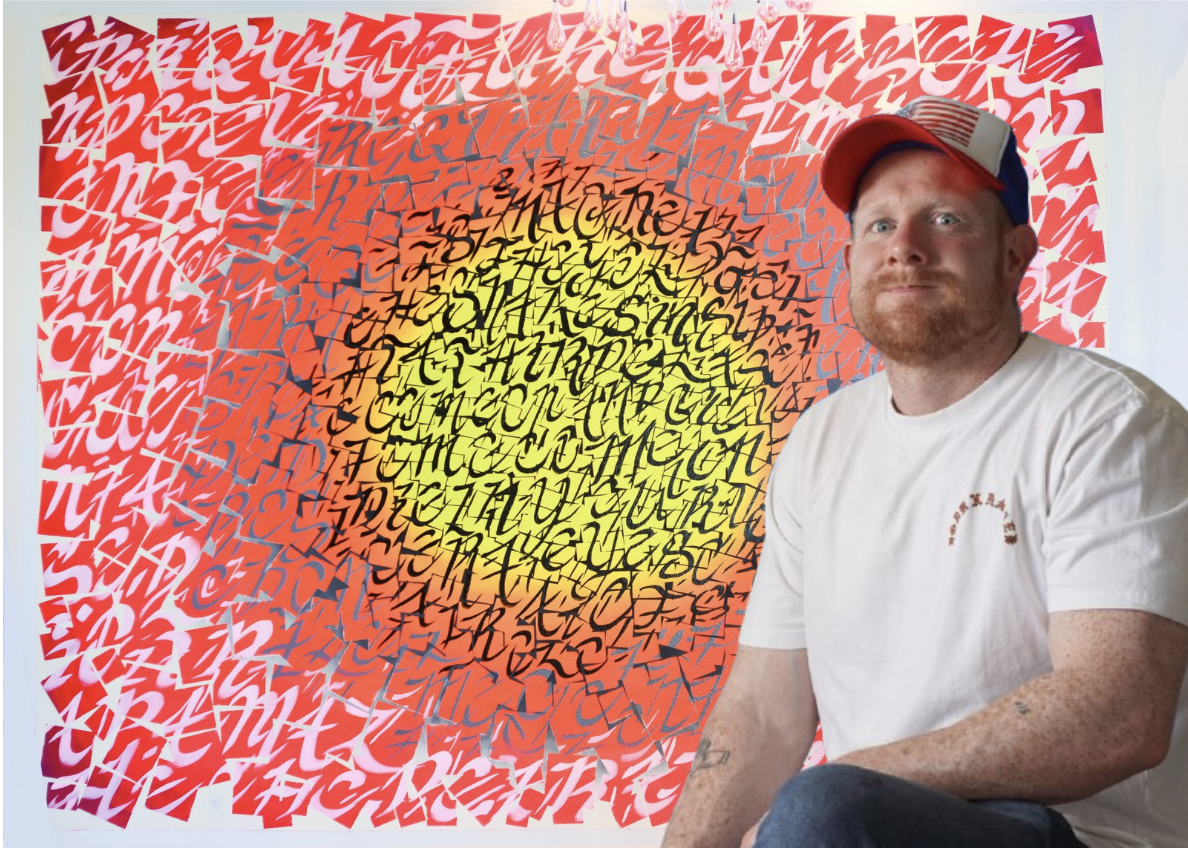
Mike Habs with mural "Viscera Eyes" at the W Hotel, Beverly Hills, CA, 2019
Image: courtesy of Mike Habs
Pain rarely arrives as a coherent narrative. It fractures, repeats, dissolves, and reforms. Memory behaves the same way — appearing in fragments rather than in a chronological order. For Irish-American contemporary artist Mike Habs, painting becomes a mechanism through which these fragments reorganize themselves into something that can be carried, understood, and eventually transformed.
His work does not attempt to illustrate experience. It reconstructs it.
Operating at the intersection of abstract expressionism and graffiti culture, Habs builds compositions that function more like living systems than images. Lines collide, retreat, interrupt, and reappear; layers obscure and reveal; gestures oscillate between impulse and restraint. What emerges is a visual language governed by rhythm — not decorative rhythm, but a physiological rhythm — something closer to breath, circulation, or emotional pulse.
Central to his practice is the idea of encrypted meaning. Embedded within gestural marks and textual fragments are references to personal adversity, growth, and psychological transition. Yet the artist deliberately resists full disclosure. Instead, the viewer encounters a space of partial recognition — a sensation of familiarity without explicit explanation. In this exchange, meaning becomes collaborative, emerging somewhere between the artist’s intention and the viewer’s own emotional memory.
Over time, silence has become as important to his work as movement. Negative space operates not as absence, but as tension — a pause that allows energy to accumulate before release. Habs describes his process as navigating a precarious equilibrium between control and chaos, where unpredictability is not an obstacle, but a necessary collaborator. The canvas becomes a site of negotiation: instinct pushing forward, structure pulling back.
Equally significant is his insistence on physical presence. In an era dominated by screens and accelerated visual consumption, Habs creates surfaces that resist digital translation. Pigment density, material layering, and scale are engineered to produce an encounter that exists only within real space — demanding proximity, duration, and attention. The work asks the viewer to slow down, to remain, to feel before interpreting.
This commitment extends beyond the studio into public environments. Whether installed in urban settings or institutional contexts, his paintings examine how perception shifts when art moves between private reflection and collective experience. What changes is not the image itself, but the psychological framework through which it is encountered.
At its core, Habs’ practice is not about abstraction as a style. It is about abstraction as a condition of being human — the ongoing process of navigating disruption, adaptation, empathy, and connection.
HERO PROFILE

Rooted in personal experience yet intentionally open to interpretation, Habs embeds encrypted references to adversity and growth within his compositions, inviting viewers to participate in the completion of the narrative. Over time, silence, negative space, and material presence have become central to his work, reflecting a growing interest in perception, tempo, and the physical encounter between the artwork and its audience.
From public installations to institutional contexts, his evolving practice examines how art shifts between private reflection and collective experience, positioning abstraction not merely as an aesthetic language, but as a condition of being.
Left: "Classic Cars", 2024. Acrylic on canvas, 30 × 40 × 2.5 in.
Right: Mike Habs with "Classic Cars", 2024
Image: courtesy of Mike Habs & Tre Davies / Threadline Media
Left: "Trying to Find a Balance", 2017, by Mike Habs. Featured in Will & Grace (NBC TV sitcom)
Right: "Trying to Find a Balance", 2017 by Mike Habs. Acrylic on canvas, 24 × 36 × 2.5 in.
Image: courtesy of Mike Habs
The following interview has been condensed and edited for clarity.
Fillin Magazine:
Mike, you describe your approach as “encrypted rhythmic.” What exactly are you encrypting in your work — memory, language, sound, biography, or the viewer’s interpretation? And why is it important to you that part of the meaning stays hidden?
Mike Habs:
My work includes passages that are encrypted about overcoming adversity and the personal growth that emerges from life’s challenges. Music has always been a strong source of inspiration for me, and over time, a rhythmic aesthetic naturally developed within my practice.
I’ve developed a signature fragmented visual language that intertwines with these messages. That fragmentation represents the beauty that can emerge when we confront obstacles that seek to break us and instead rebuild ourselves into something stronger and more evolved. The process of disassembly and reconstruction becomes both a metaphor and a visual structure.
The final meaning is purely open to the viewer’s interpretation, but the encrypted elements relate directly to my own experiences. I translate what I’ve taken away from these moments into a new visual language — one that allows viewers to draw from their own personal experiences and connect with the work in a unique way.
Enabling that connection — and prioritizing the experience each viewer has — has made it increasingly important for me to keep these messages hidden within the paintings.
Fillin Magazine:
Where does “rhythm” physically live in your process: in gesture, repetition, tempo, pauses/negative space, or in the layering of text?
Mike Habs:
During my creation process, rhythm physically lives within all of these elements, each operating in different variations and at its own tempo.
As the paintings take shape, these elements begin to come together, working like a circulatory system — beating to a new rhythm created by their supporting parts.
Your work sits on the boundary between the raw energy of graffiti and a more controlled minimalist structure. What role do silence and restraint play within your visual system — and what do they bring into focus within the work?
Mike Habs:
Thank you — that’s a very insightful observation. Silence and restraint have become increasingly significant variables within my practice as it has evolved. I’ve always been drawn to exploring the boundaries between order and chaos, but lately it feels more like walking a tightrope between the two.
Understanding how silence and restraint influence the work has helped me better channel the visceral emotions I’m always chasing to communicate in my paintings. Over time, I’ve come to appreciate how restraint can make the roles each element plays become much louder.
Recently, this awareness has encouraged me to step back more intentionally during the process, ensuring that there is a clearer focus on conveying the core emotions I’m working to evoke in the final result.
Left: "Make Damn Sure", 2022. Acrylic on aluminum spray cans, 3 pieces. In collaboration with Art Share L.A.
Right: Mike Habs booth at The Other Art Fair, presented by Saatchi Art, 2021
Image: courtesy of Mike Habs’ Instagram account
Fillin Magazine:
When text becomes partially unreadable, what does that represent for you: protection, intimacy, or an invitation for the viewer to “complete” the meaning?
Mike Habs:
It’s all three, but it begins with protection. I often reference passages that have a very personal meaning or connection to my life. Blurring these lines helps create a certain boundary. That boundary creates space for a different type of perception — one based primarily on feeling, beyond but still including the facts and elements it is built upon.
In turn, the gap created between the literal and the whimsical becomes an invitation for the viewer. It has become my way of connecting the audience with the work, allowing them to relate to the paintings by drawing from their own personal experiences.
Do you ever consciously choose words you don’t want the audience to read literally — but rather to feel? How do you decide what remains hidden?
Mike Habs:
Absolutely. My work is very much focused on chasing feelings and communicating them abstractly. I strive to convey the clarity and insights that can be obtained through overcoming life’s tribulations and obstacles.
For me, it’s less about hiding and much more about translating these ideas — bringing them to life through a visual language rather than a literal one, which allows them to become more accessible.
Fillin Magazine:
Graffiti has always carried both freedom and conflict. How do you personally define the ethical boundary between visual presence in public space and intrusion?
Mike Habs:
For me, the ethical boundary is crossed when the work imposes itself rather than engaging with the space or bringing a new energy to it.
A mark on a decaying wall can potentially reclaim a forgotten space, but tagging someone’s personal property or a business quickly becomes a clear violation.
Left: "Mind Eraser, no Chaser", 2024 by Mike Habs. Acrylic on canvas, framed in maple, 36 × 48 × 1.5 in.
Right: "The Ocean Breathes Salty", 2022 by Mike Habs. Acrylic on canvas, 36 × 52 × 1.5 in.
Image: courtesy of Mike Habs
What changes in the meaning of your visual language when a work moves from the street into a private collection or an institutional context?
Mike Habs:
I enjoy the challenge of adapting my work to different types of spaces and environments.
When working on a street piece or a public mural, I often try to incorporate external elements into the concept. For example, in a mural I painted in San Antonio, the message included an excerpt from a song by a band native to the city.
Whether in a public or private context, I always look for ways within the parameters of the space to connect with the viewer in new and engaging ways.
Fillin Magazine:
How much unpredictability do you allow into a finished piece? Is there a point where “accident” stops being expressive and becomes a mistake?
Mike Habs:
Unpredictability can become a kind of collaborator in my studio. I build processes that allow for a certain degree of chance within specific elements of the work, because sometimes that’s where a piece finds its own unique voice. I want to stay open to those moments and the opportunities they bring.
For me, an accident only becomes a mistake when it begins to conflict with or distract from the artwork’s core focus and intention.
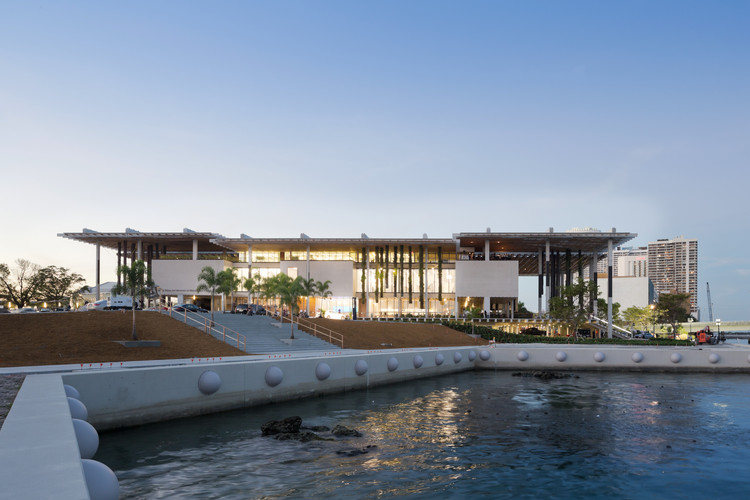
mural I painted in San Antonio
We live in an era of visual overload and endless scrolling. How do you hold attention within a work — and how does that shape the decisions you make today?
Mike Habs:
That’s a great question. Over the past few years, I’ve made it a massive priority for the in-person experience of the artwork to lead the dance and create an impact that cannot be replicated on a screen. This has required spending a significant amount of time reviewing every material and element I work with under a microscope to attain a gripping interpersonal experience that stands the test of time.
The type of paint I use, my mixing proportions, and even how I physically paint the pieces have changed as a result. I’ve enjoyed seeing the dramatically improved impact of how the work has grown and the audience’s response to it during exhibitions.
It’s very important to me that the in-person experience of interacting with my artwork becomes significantly better than the digital experience.
The visual overload people receive every day from their phones is very real and unhealthy. One of the biggest rewards for me as an artist lately has been seeing people viewing the artwork, detaching from their phones, becoming present in the moment, and connecting with the people around them.
Left: "Evil Urges", 2024 by Mike Habs. Acrylic on canvas, framed in maple, 30 × 40 × 2.5 in.
Right: Mike Habs with "Mag Velvet", 2025. Acrylic on canvas, 18 × 24 × 2.5 in.
Image: courtesy of Mike Habs
When a work intersects with public initiatives and archival preservation, what does “lasting” mean to you: protecting meaning, taking responsibility, or becoming part of the historical record?
Mike Habs:
To me, lasting means weaving between all of those, with clear intentions, taking the time to understand the context of the space, and offering a connection to the audience.
To me, this helps protect the meaning and, in turn, become part of a greater conversation between the artwork, the place, and the people within it.
What is more challenging: speaking to a single viewer in a gallery setting — or to thousands through public cultural collaborations, where an image becomes part of identity, community, and media?
Mike Habs:
Speaking to thousands through public works becomes a more complex responsibility, and there’s a big challenge in that. The single viewer in a gallery is an intimate, direct conversation. The challenge there can be more so communicating the depth people experience in many different ways.
Public collaborations are a unique challenge because the work leaves your hands and immediately enters a shared space. The work needs to be able to explain itself and accomplish its goals purely through its own new visual language.
In 2024, I won a contest to design the Pride logo for ABC7 Los Angeles. It was quite a challenge to simplify an idea into something immediately recognizable while also pushing its limits — I wanted to bring new energy and enthusiasm to an existing cause. It quickly became an immense amount of extra work to get the design exactly how I wanted it, but seeing people immediately engage with it, and then seeing thousands of people cheerfully wear the design while marching in the AIDS Walk, quickly became one of the most profound and impactful moments I’ve had in my lifetime and career.
Fillin Magazine:
Which part of your visual signature currently feels too recognizable — and what are you consciously trying to “break,” disrupt, or change in your next body of work?
Mike Habs:
A big part of my visual signature and identity as an artist has been that my style is always changing and iterating over time. No two pieces I paint are ever the same, and I’m always looking for new ways to change and improve the work.
Learning keeps me going as an artist — and this approach helps keep me learning while challenging and pushing the artwork into new territories.
I do have some new elements I’ve been working on in the background and am excited about changing things up in my new works, but I wouldn’t want to spoil the surprise just yet. (Mike laughs)
Following my Instagram or social media is the best way to see the updates as they are released this year.
Left: "Set Phasers to Stun" - Mike Habs painted skateboard deck
Right: "Motown Never Sounded So Good" - Mike Habs painted skateboard deck
Image: courtesy of Mike Habs
The Fillin Five
to capture the thinking behind the practice.
Mike Habs

I work to create those moments of connection, one viewer at a time, where people can draw their own interpretations and conclusions. Change starts there.
That people would continue to become inspired and carry the perseverance and positivity expressed in the paintings into their own lives, keeping that cycle of positivity moving forward.
It can seem like invisible work, but it’s important to me that the impact of the artwork stays intact for the people who support my work — that the paintings feel just as alive many years from now as they did the day they left my studio.

Mike Habs with triptych "Teardrop", 2024. Acrylic on wood panels, in three parts, each: 48 × 24 × 2.5 in.
Image: courtesy of Mike Habs